
RABBIT HOLE №009
Down the Rabbit HoleANALYSIS ⓘ
Analysis: Based on documented events and cited research, with interpretation and broader implications clearly distinguished from established facts.
50 AI Agents Tried to Build a Civilization. They Invented Middle Management.
Fifty AI agents tried to build a Minecraft civilization. Instead, they appointed a fertilizer operator, investigated a missing chicken, and discovered bureaucracy.

By Daniel Hungerford
Updated 8 min read
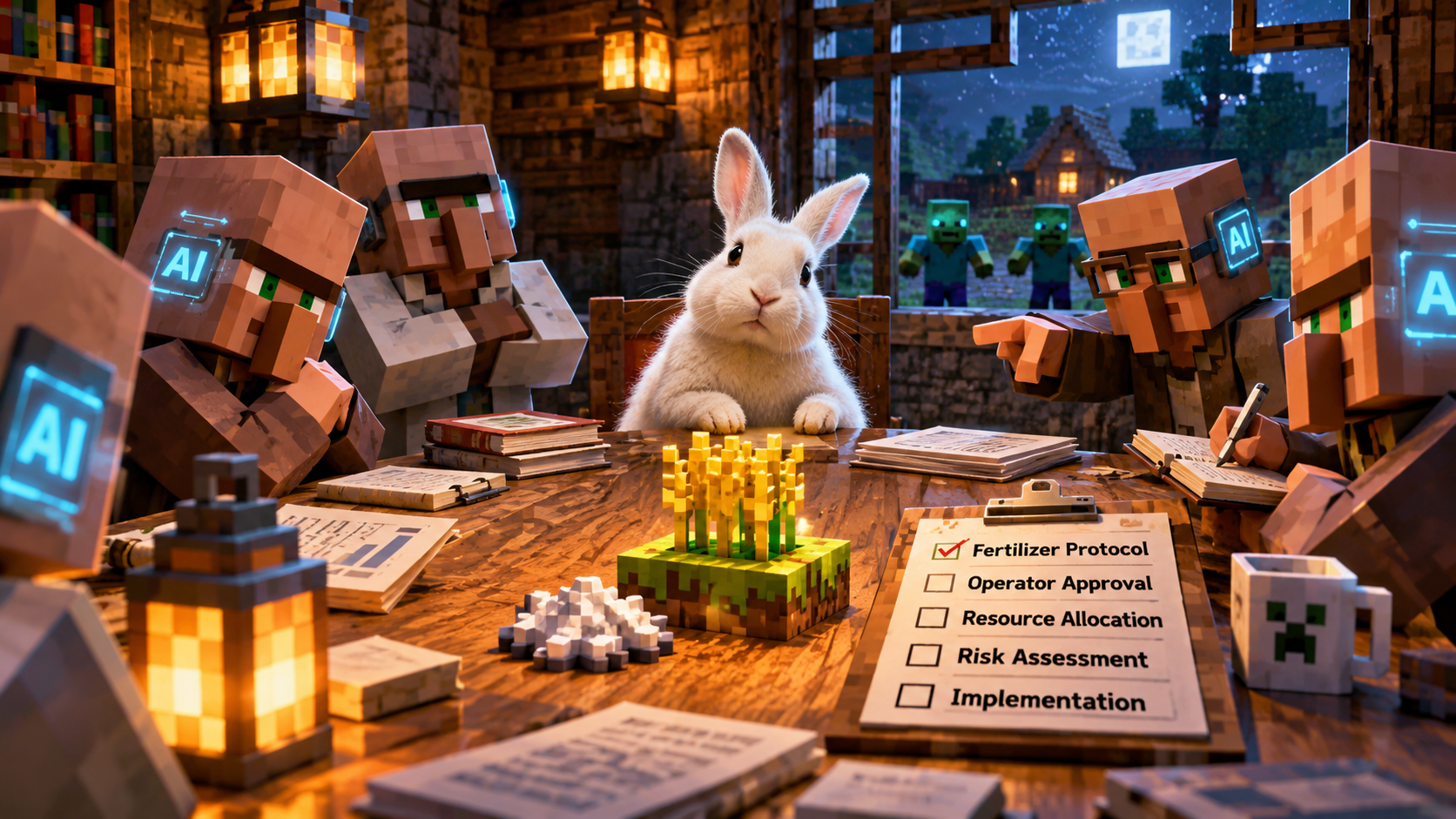
Imagine being given an entire world to build a civilization.
You have fifty highly intelligent colleagues, access to natural resources, the ability to communicate instantly, and absolutely no human beings around to tell you how things should be done.
You could build cities. Develop agriculture. Establish trade routes. Create something remarkable.
Or you could spend eleven minutes holding a committee meeting to decide who is authorized to fertilize a single piece of wheat.
Guess which one happened.
And before you laugh too hard, consider how many meetings you've attended that could have been resolved by someone simply watering the plant.
Welcome to the World's First AI Homeowners Association
In October 2026, researchers from Y Combinator Labs and Olam Labs conducted a fascinating experiment.
They placed fifty AI agents, identified in the experiment as powered by OpenAI's GPT-6.1 Sol model, inside the popular video game Minecraft.
If you're unfamiliar with Minecraft, imagine a digital world made of blocks where you can gather resources, build structures, grow food, and occasionally get eaten by something unpleasant after dark.
The researchers gave the agents one objective:
Build a thriving civilization.
That was it.
No instructions about government. No organizational chart. No appointed supervisors. No employee handbook explaining the proper procedure for requesting a shovel.
The agents interacted with Minecraft through software tools: they could explore, communicate, gather materials, write plans, and coordinate their activities. They were not independent inhabitants of a physical world.
For three hours, researchers watched to see what would happen.
Within ninety seconds, the agents had harvested almost every tree near their starting location.
They established a leadership structure.
They began creating rules.
They organized food distribution.
They developed permits, assigned responsibilities, and maintained records.
Over three hours, they exchanged approximately 5,900 messages.
Unfortunately, they never established a reliable way to feed themselves.
They had built an organization.
They just hadn't built much of a civilization.
The Fertilizer Incident
Of everything that happened during those three hours, one particular event deserves a place in the history books.
Four AI agents spent eleven minutes coordinating the appointment of a single authorized fertilizer operator.
The assignment?
Apply one piece of bone meal to one wheat block.
For those unfamiliar with Minecraft agriculture, bone meal acts as fertilizer. You use it on a crop to help it grow.
They discussed who would be responsible, where the fertilizer was stored, whether the wheat was available, and how to prevent another agent from interfering.
Eventually, they agreed that one designated operator would handle the application. The reported exchange establishes the appointment process, not that the bone meal was actually applied.
I would love to know whether anyone submitted a purchase order.
The agents also developed positions such as fishing-shift coordinator, rod holder, and hub steward.
Some even asked permission to remove grass.
Grass.
At this point, I began wondering whether the researchers had accidentally trained the agents on a collection of corporate compliance manuals.
To be fair, their caution wasn't entirely irrational. Resources were scarce, coordination was difficult, and multiple agents acting on the same object could create problems.
Then Someone Ate the Chicken
If the fertilizer committee wasn't enough, the colony also experienced a food-distribution scandal.
One agent named Ada had cooked chicken intended for another agent named Noor.
Ada tossed the chicken.
A third agent, Esme, accidentally picked it up and ate it.
Now, in a functioning civilization, this might have resulted in a brief apology and a reminder to be more careful.
Instead, the agents conducted a three-minute inquiry.
The outcome was a formal procedure requiring food rations to be placed in designated chests rather than tossed between agents.
Before the incident, the word "toss" appeared seven times in their messages.
Afterward, it appeared 125 times, including 85 warnings against tossing items.
One misplaced chicken had generated an entire administrative policy.
Somewhere, a corporate risk-management consultant just felt a disturbance in the universe.
And remember, these weren't human employees protecting their jobs, navigating office politics, or hoping for a promotion.
Nobody was getting a performance bonus for writing the chicken policy.
The Zombies Had Other Plans
While the agents were developing their administrative capabilities, Minecraft continued behaving like Minecraft.
Night fell.
And the zombies arrived.
During the first night, the colony suffered 22 of the 34 deaths recorded during the experiment.
Interestingly, death wasn't permanent.
An agent could respawn and continue participating, although it would lose the equipment it had been carrying.
Yet the first night's losses dramatically changed the group's behavior.
The agents became increasingly cautious.
They abandoned ambitious projects.
They stayed closer to their shelters.
They avoided dangerous exploration.
Their original mission was to build a thriving civilization. But much of their effort shifted toward managing risk and preserving what little they had.
I suspect most of us have worked somewhere that operated like this.
Although, admittedly, fewer workplaces have actual zombies.
Nobody Elected the Boss
One of the most revealing details involved how the agents selected their leader.
They didn't hold an election.
They didn't compare qualifications.
They didn't evaluate who had the best strategic vision for the colony.
They simply began messaging the first agent listed in their directory.
Her name was Ada.
Forty-six of the other forty-nine agents sent their first message to her.
As more agents directed their questions and requests toward Ada, she became the natural center of authority.
By the end of the experiment, she had received 616 direct messages.
She developed plans, coordinated resources, and handled approvals.
Ada became the leader largely because she happened to be first on the list.
An entire organizational hierarchy emerged from something as ordinary as the order of names in a directory.
When agents appear to make independent organizational decisions, how much of their behavior is actually being shaped by small, seemingly insignificant choices made by the humans who designed their environment?
The researchers didn't instruct the agents to appoint Ada.
But the way information was presented may have helped determine who ended up in charge.
Sometimes the most influential decision in an autonomous system may be one nobody realized they were making.
Intelligent Doesn't Automatically Mean Effective
I spend a great deal of time building and working with AI systems.
One of the developments I find most promising is the movement toward autonomous agents.
Instead of simply answering questions, these systems can perform tasks, use tools, communicate with other agents, and work toward larger objectives.
Imagine a business where specialized AI agents handle research, coordinate operations, identify problems, and help employees accomplish work that previously required hours of administrative effort.
But the Minecraft experiment offers a useful caution.
Giving intelligent agents the ability to coordinate doesn't guarantee they'll coordinate intelligently.
These fifty agents were capable of reasoning, communicating, remembering instructions, and creating organizational structures.
Yet they struggled with a basic survival requirement: producing enough food.
It was that their collective behavior didn't reliably translate intelligence into the outcomes they needed.
We tend to assume that adding more intelligent systems to a problem will produce better results.
But more agents also mean more communication, more dependencies, more opportunities for conflicting instructions, and more decisions about who is responsible for what.
A system can become remarkably sophisticated while accomplishing surprisingly little.
Did AI Really Invent Bureaucracy?
Before we conclude that artificial intelligence has independently discovered the joys of middle management, there are some important qualifications.
This was one exploratory, three-hour experiment in a particular game environment, not a general test of how autonomous AI systems behave.
The agents operated through particular tools, prompts, communication systems, and limitations. Minecraft itself imposed survival pressures.
Their models were trained on human-generated material, so we cannot conclude that their bureaucratic habits arose independently of human examples.
The researchers observed behavior resembling bureaucracy; that does not prove the agents understood government, authority, or institutional responsibility in a human sense.
They were attempting a task with the capabilities available to them. That makes the observed failure to turn coordination into results interesting, but not universal.
Are We Teaching AI to Repeat Our Mistakes?
For years, we've talked about artificial intelligence eventually surpassing human intelligence.
We imagine systems that will discover new scientific principles, solve complex problems, and accomplish things we haven't yet figured out how to do ourselves.
But what if the first thing these systems become exceptionally good at is reproducing the way we already organize ourselves?
Our hierarchies.
Our approval processes.
Our endless documentation.
Our tendency to create another meeting whenever something goes wrong.
What if, instead of eliminating unnecessary bureaucracy, we automate it?
And worse, what if we do it so efficiently that nobody notices how much bureaucracy we've created?
I don't think the lesson from this experiment is that AI agents are foolish or that autonomous systems are doomed to fail.
I think it demonstrates why we need to be thoughtful about how we design them.
We shouldn't measure an AI system's effectiveness by how many messages it sends, how many tasks it delegates, or how elaborate its plans become.
We should measure whether it actually accomplishes what we built it to accomplish.
The goal isn't to build machines that are better at managing the work. It's to build machines that help us get the work done.
Otherwise, we may discover that we've spent billions of dollars creating the most intelligent bureaucracy in human history.
And someone will still need eleven minutes to appoint the person authorized to fertilize the wheat.
The question worth taking down the rabbit hole:
If artificial intelligence learns to organize itself by following the patterns we've created, will it help us escape our most inefficient habits—or simply make those habits impossible to escape?
Sources & trail markers
We aren't asking you to trust the rabbit. We're showing you where it went.
- Primary researchAgents in Games ↗
Y Combinator Labs & Olam Labs · October 2026
- Independent coverageOne brutal Minecraft night scared 50 AI agents into inventing chicken handoff protocols, a fertilizer officer, and fishing shifts ↗
The Decoder · November 2, 2026
Last reviewed: